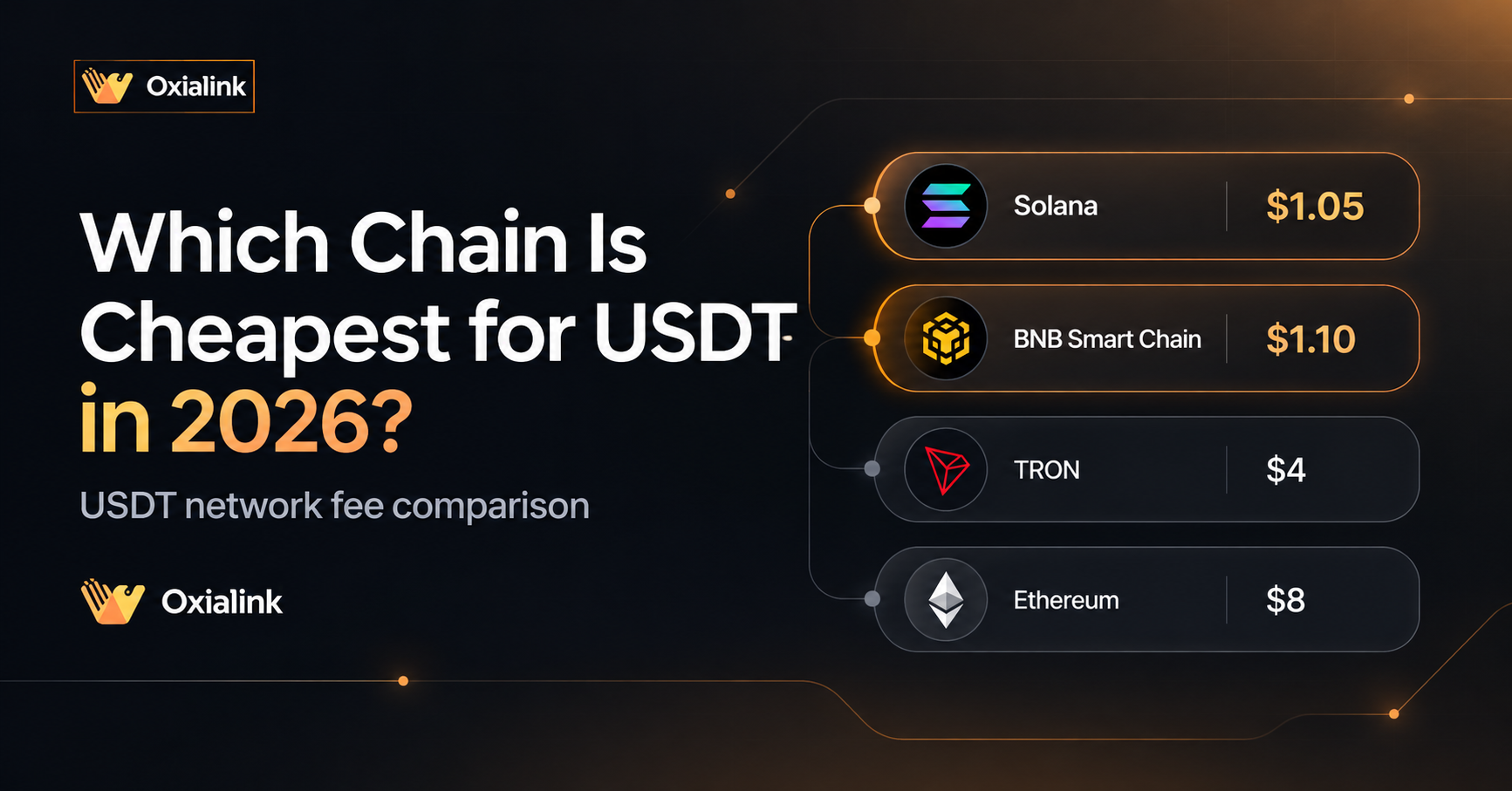
If you accept USDT, the network you choose can change what each payment actually costs you. Based on Oxialink's current network fees, Solana is the cheapest chain for accepting USDT, at a fixed network fee of $1.05 per payment. BNB Smart Chain is close behind at $1.10, while USDT on TRON costs $4 and Ethereum costs $8. That is only part of the calculation, though. Your total cost also includes Oxialink's processing fee, and the fixed network fee matters much more on smaller payments than larger ones. Here is the full maths.
The short answer
- USDT on Solana: $1.05 network fee per payment
- USDT on BNB Smart Chain (BEP20): $1.10 network fee per payment
- USDT on TRON (TRC20): $4 network fee, or $2.80 with Gas Station
- USDT on Ethereum (ERC20): $8 network fee, or $5 with Gas Station
- Oxialink processing fee: 0.5% on Free or 0.2% on Premium
For merchants choosing between the main USDT networks, Solana currently has the lowest fixed network fee in Oxialink's fee schedule. BNB Smart Chain is only $0.05 higher, so both are worth considering for merchants who want to keep network costs low. The right choice still depends on your average order value, where your customers already hold USDT, and whether you use Gas Station.
How USDT payment fees actually work
There are two different costs to understand when you accept a USDT payment through Oxialink:
- 1Processing fee: the percentage charged according to your Oxialink plan.
- 2Network fee: a fixed amount for the coin and network used.
The network fee is not added to the customer's invoice as a separate percentage. It is taken out of the payment amount. For example, if a customer pays you $100 in USDT on Solana and you are on the Free plan, the processing fee is 0.5%, or $0.50. The current Solana network fee is $1.05. That means the combined cost is $1.55 on a $100 payment. The same $100 payment on USDT-TRC20 would have a $0.50 processing fee plus a $4 network fee, for a total of $4.50. The percentage processing fee stays the same. The fixed network fee is what creates the biggest difference between chains.
USDT network fees compared
Here is the current Oxialink fee data for the supported USDT networks.
| USDT network | Network fee | With Gas Station | Free plan processing | Premium processing |
|---|---|---|---|---|
| Solana | $1.05 | $1.05 | 0.5% | 0.2% |
| BNB Smart Chain (BEP20) | $1.10 | $0.50 | 0.5% | 0.2% |
| TRON (TRC20) | $4.00 | $2.80 | 0.5% | 0.2% |
| Ethereum (ERC20) | $8.00 | $5.00 | 0.5% | 0.2% |
| TON | $1.10 | $1.10 | 0.5% | 0.2% |
The network fee is charged at cost rather than as another percentage.
1. USDT on Solana: the lowest current network fee
USDT on Solana has the lowest fixed network fee in the current Oxialink schedule: $1.05 per payment. There is no Gas Station discount listed for USDT on Solana because the current fee is already set at $1.05. That makes Solana particularly straightforward to compare. Your cost is the plan processing percentage plus the $1.05 network fee.
What does that mean on different order sizes?
On the Free plan, the processing fee is 0.5%. For a $50 payment:
- Processing fee: $0.25
- Network fee: $1.05
- Total: $1.30
- Effective cost: 2.6%
For a $100 payment:
- Processing fee: $0.50
- Network fee: $1.05
- Total: $1.55
- Effective cost: 1.55%
For a $500 payment:
- Processing fee: $2.50
- Network fee: $1.05
- Total: $3.55
- Effective cost: 0.71%
For a $1,000 payment:
- Processing fee: $5
- Network fee: $1.05
- Total: $6.05
- Effective cost: 0.605%
This illustrates an important point: a fixed network fee has a bigger percentage impact on small payments. The $1.05 network fee does not change when the payment goes from $50 to $1,000. The processing percentage does. If you sell higher-value products or services, that fixed network cost becomes a smaller part of each transaction. For more detail on the asset itself, see USDT on Solana.
2. USDT on BNB Smart Chain: almost tied with Solana
USDT on BNB Smart Chain, also written as USDT on BNB Smart Chain (BEP20), has a current network fee of $1.10. That is only $0.05 more than Solana. For many merchants, the difference between $1.05 and $1.10 will be too small to make the decision by itself. BNB Smart Chain also has an important advantage if you use Oxialink's Gas Station. The current network fee for USDT payouts can fall from $1.10 to $0.50 with a funded Gas Station. That makes the maths different for merchants who withdraw their balances regularly. On the Free plan, a $100 payment would look like this without Gas Station:
- Processing fee: $0.50
- Network fee: $1.10
- Total: $1.60
- Effective cost: 1.6%
With the Gas Station network fee:
- Processing fee: $0.50
- Network fee: $0.50
- Total: $1.00
- Effective cost: 1%
The Gas Station is optional. It does not change the 0.5% Free plan processing fee. See the USDT BEP20 payment page for the network-specific details.
3. USDT on TRON: popular, but not the cheapest here
USDT on TRON (TRC20) is widely used for crypto payments, but its current Oxialink network fee is significantly higher than Solana or BNB Smart Chain. The standard network fee is $4 per payment. With a funded Gas Station, the network fee falls to $2.80. That is still higher than the $1.05 Solana fee and the $0.50 BNB Smart Chain Gas Station fee. This is why it would be misleading to simply call TRON the cheapest USDT network. Consider a $100 payment on the Free plan. Without Gas Station:
- Processing fee: $0.50
- Network fee: $4
- Total: $4.50
- Effective cost: 4.5%
With Gas Station:
- Processing fee: $0.50
- Network fee: $2.80
- Total: $3.30
- Effective cost: 3.3%
The difference becomes much less significant on a larger order, but it does not disappear. For example, on a $1,000 payment on the Free plan with the standard $4 network fee:
- Processing fee: $5
- Network fee: $4
- Total: $9
- Effective cost: 0.9%
The percentage falls because the same $4 fixed fee is spread across a larger payment. That is exactly why comparing network fees without considering order value can give merchants the wrong impression. You can check the current details on the USDT-TRC20 payment page.
4. USDT on Ethereum: the highest current network fee
USDT on Ethereum (ERC20) has the highest network fee among the main USDT options in the current Oxialink schedule. The standard network fee is $8. With Gas Station, the listed fee is $5. That makes Ethereum considerably more expensive for smaller USDT payments. For a $100 payment on the Free plan:
- Processing fee: $0.50
- Network fee: $8
- Total: $8.50
- Effective cost: 8.5%
With Gas Station:
- Processing fee: $0.50
- Network fee: $5
- Total: $5.50
- Effective cost: 5.5%
At $1,000, the same standard network fee becomes a much smaller percentage:
- Processing fee: $5
- Network fee: $8
- Total: $13
- Effective cost: 1.3%
So Ethereum is not automatically unusable for payments. The question is whether its network and customer base make sense for your business at the payment sizes you handle. If your customers already use Ethereum-based USDT and your average order value is high, you may still have a reason to support it.
What about USDT on TON?
The current Oxialink fee schedule lists a $1.10 network fee for USDT on TON. That puts it close to BNB Smart Chain and slightly above Solana. However, the cheapest fee alone should not determine your integration choice. The network your customers actually use matters too. If most of your customers already hold USDT on another network, choosing a network purely because its fixed fee is a few cents lower may create a worse checkout experience. For that reason, merchants should consider customer demand alongside the fee table.
Free vs Premium: which plan changes the calculation?
Oxialink currently has two plans:
| Plan | Processing fee | Monthly fee |
|---|---|---|
| Free | 0.5% | $0 |
| Premium | 0.2% | $24.99 |
Both plans charge the network fee at cost. The important difference is the processing percentage. On a $1,000 payment: Free plan 0.5% of $1,000 = $5 processing fee. Premium plan 0.2% of $1,000 = $2 processing fee. That is a $3 difference on one $1,000 payment before the network fee is considered. For example, with USDT on Solana:
| Payment | Free processing | Premium processing | Solana network fee |
|---|---|---|---|
| $100 | $0.50 | $0.20 | $1.05 |
| $500 | $2.50 | $1.00 | $1.05 |
| $1,000 | $5.00 | $2.00 | $1.05 |
| $5,000 | $25.00 | $10.00 | $1.05 |
The network fee stays fixed while the processing fee grows with the payment. Premium costs $24.99 per month, so merchants should compare that subscription against the processing-fee savings they expect to make. There is no setup fee, KYC fee or monthly minimum.
When does Premium make sense?
The simple calculation is: Processing savings = payment volume × 0.3% The difference between the Free plan's 0.5% and Premium's 0.2% is 0.3 percentage points. At $1,000 in payment volume, the saving is $3. At $5,000, it is $15. At $10,000, it is $30. So at around $8,330 in monthly payment volume, the 0.3% processing-fee saving is roughly equal to Premium's $24.99 monthly price. That is a mathematical break-even point, not a promise that Premium is the right plan for every merchant. Your actual payment volume, average order value and network usage should determine the decision.
Why the cheapest chain is not always the cheapest payment
There is a subtle difference between the cheapest network fee and the cheapest total payment. Solana has the lowest current fixed network fee for USDT at $1.05. But suppose one customer pays $20. On the Free plan:
- Solana processing fee: $0.10
- Solana network fee: $1.05
- Total: $1.15
- Effective cost: 5.75%
Now consider a $2,000 payment:
- Solana processing fee: $10
- Solana network fee: $1.05
- Total: $11.05
- Effective cost: 0.5525%
The network itself did not become cheaper. The fixed fee simply became a smaller percentage of the transaction. This is why merchants should look at effective cost at their actual order value, rather than choosing a network from a headline fee alone.
Gas Station can change the answer
Oxialink's Gas Station is designed to reduce the network fee on token payouts. The current fee data shows:
- USDT on BNB Smart Chain: $1.10 → $0.50
- USDT on TRON: $4 → $2.80
- USDT on Ethereum: $8 → $5
That can make a meaningful difference for merchants who withdraw frequently. The Gas Station is optional and requires funding. It does not apply to every supported asset or network. The important point is that you should compare the actual fee for your intended network and withdrawal setup, rather than assuming every chain receives the same discount.
Receiving payments and withdrawing are different costs
Another detail merchants sometimes miss is that the network fee does not only matter when the customer pays. Oxialink's fee schedule also applies a plan percentage plus a network fee when you withdraw your balance. The current API describes the network fee as the on-chain cost of receiving the payment and sending it out again. That means your real payment economics should include what happens after the money reaches your Oxialink balance. For example, if you receive many small orders and withdraw after every order, you can end up paying a network fee repeatedly. If you withdraw in batches, the network fee can be paid once for the batch rather than once per order. That can matter more than a small difference between two network fees.
Why batch withdrawals matter
Imagine a merchant receives 10 payments and withdraws each one separately. If the applicable network fee is $1.05 per withdrawal, those 10 withdrawals would involve $10.50 in network fees. A batch withdrawal can reduce the number of on-chain transactions and therefore the number of network fees paid. The exact economics depend on the withdrawal setup and applicable fee, but the principle is simple: Don't compare only the checkout fee. Look at the complete flow from customer payment to your own wallet. Oxialink supports auto-withdrawal and batch withdrawals, so merchants can choose a withdrawal workflow that fits their operation.
What about minimum payments?
Each network also has a minimum payment amount. For the main USDT networks currently listed:
- USDT on Solana: minimum $8
- USDT on BNB Smart Chain: minimum $8
- USDT on TRON: minimum $15
- USDT on Ethereum: minimum $9
- USDT on TON: minimum $8
Payments below the minimum are not credited and cannot be refunded because the network cost of moving them exceeds their value. This matters if your business sells low-priced products, subscriptions or digital services. A network with a low fee may still not be suitable if your typical order is below its minimum payment threshold.
So, which chain should you choose?
There is no single network that makes sense for every merchant. Here is the practical way to think about the current Oxialink options.
Choose Solana if
You want the lowest current fixed network fee for USDT. At $1.05 per payment, USDT on Solana is currently the lowest-cost USDT network in Oxialink's fee schedule. It also has an $8 minimum payment. For merchants focused on keeping network costs low, this is the strongest starting point.
Choose BNB Smart Chain if
Your customers already use BEP20 and you want a low network fee. The standard fee is $1.10, only $0.05 above Solana. With Gas Station, the listed payout network fee falls to $0.50. See the BNB Smart Chain payment integration for the current details.
Choose TRON if
Your customers specifically use TRC20 and that network is important to your business. TRON's current fee is higher at $4, or $2.80 with Gas Station. It is therefore not the cheapest option in this comparison, but customer network preference can still make it a practical choice.
Choose Ethereum if
Your customers specifically need ERC20 USDT and the higher network cost is acceptable for your payment sizes. The current network fee is $8, or $5 with Gas Station. For smaller payments, that fixed fee has a large impact on the effective cost.
The 0.6% claim: when does it apply?
Oxialink can make one specific total-cost claim: Pick a cheap chain and take Premium, and the total cost lands around 0.6% all in. This applies to USDT via Solana or BNB Smart Chain under the relevant payment conditions. For example, on a $1,000 Solana payment with Premium:
- Processing fee: $2
- Network fee: $1.05
- Total: $3.05
- Effective cost: 0.305%
So why does the brief describe the total as around 0.6% all in? Because the network fee is a fixed amount, not a percentage. As transaction size changes, its effective percentage changes too. That is exactly why we do not describe Oxialink as “the cheapest gateway.” On high-volume USDT-TRC20 transactions, the fixed network cost can make the total cost higher than other options. A fair comparison needs to show the numbers and let merchants decide.
What is the cheapest USDT network for small payments?
For the current Oxialink fee schedule, Solana has the lowest fixed network fee at $1.05. But for small payments, the network fee becomes a larger percentage of the transaction. For example, on a $20 payment, the $1.05 Solana network fee alone represents 5.25% of the payment. That is before the processing fee. So if your average order value is very low, you should calculate your effective cost rather than simply selecting the chain with the lowest fixed fee. The minimum payment also matters.
What is the cheapest USDT network for larger payments?
Solana remains the lowest fixed-fee option in the current Oxialink data. However, the difference between networks becomes less important as payment size increases because the processing fee becomes a larger part of the total. For a $10,000 payment on Premium:
- Solana: $20 processing + $1.05 network = $21.05
- BNB Smart Chain: $20 processing + $1.10 network = $21.10
- TRON: $20 processing + $4 network = $24
- Ethereum: $20 processing + $8 network = $28
At this payment size, Solana and BNB Smart Chain are effectively separated by only $0.05. The bigger difference is between the low-fee networks and Ethereum.
Don't choose a network from the headline fee alone
A merchant choosing a crypto payment gateway should look at at least four things: 1. Processing fee Is it 0.5% or 0.2%? 2. Network fee How much is charged for the network you actually want to use? 3. Average order value How much does that fixed network fee represent as a percentage of each payment? 4. Withdrawal pattern Are you withdrawing after every order or batching withdrawals? You should also consider where your customers already hold USDT. A network that is theoretically cheaper can create unnecessary friction if your customers are using a different network.
Test before you go live
You do not have to guess how a crypto payment flow behaves before putting it on your live store. Oxialink provides a free sandbox on public testnets. The sandbox runs the same build as production on TRON Nile, TON testnet and BNB Smart Chain testnet. Test coins are available through faucets, so you can work through a payment flow without using real money. If you are building an integration, start with the Oxialink sandbox and test the complete payment flow before accepting a live payment. For developers, the Oxialink API documentation covers the integration side. For merchants using WooCommerce, you can also read our guide on how to accept crypto payments in WooCommerce.
Frequently asked questions
Which chain is cheapest for USDT in 2026?
Based on Oxialink's current fee data, USDT on Solana has the lowest fixed network fee at $1.05 per payment. BNB Smart Chain is close behind at $1.10.
Is USDT cheaper on TRON or Solana?
With Oxialink's current network fees, Solana is cheaper. USDT on Solana has a $1.05 network fee, while USDT on TRON (TRC20) has a $4 standard network fee or $2.80 with Gas Station.
Is USDT on BNB Smart Chain cheaper than USDT on TRON?
Yes, based on the current Oxialink network fees. USDT on BNB Smart Chain has a $1.10 standard network fee, compared with $4 for USDT on TRON.
What is the cheapest network for accepting USDT?
For Oxialink merchants, Solana currently has the lowest fixed network fee for USDT at $1.05. BNB Smart Chain is close at $1.10. Your actual effective cost also depends on the payment amount and Oxialink plan.
Does Oxialink charge a percentage fee on top of the network fee?
Yes, the Free plan has a 0.5% processing fee and Premium has a 0.2% processing fee. The network fee is a separate fixed cost charged at cost.
Does Oxialink support USDT on TRON?
Yes, Oxialink supports USDT on TRON (TRC20). The current network fee is $4, or $2.80 with Gas Station.
Can Gas Station reduce USDT network fees?
Yes, Oxialink's Gas Station can reduce the network fee on eligible token payouts. The current fee data lists USDT on BNB Smart Chain at $0.50 with Gas Station, USDT on TRON at $2.80, and USDT on Ethereum at $5.
Should I choose Solana or BNB Smart Chain for USDT?
Both have low current network fees on Oxialink. Solana is $1.05 and BNB Smart Chain is $1.10. If your customers already use one network, that existing preference may be more important than the $0.05 difference.
The Bottom Line
If your only question is which chain is cheapest for USDT, the current answer is Solana, with a $1.05 fixed network fee on Oxialink. BNB Smart Chain is almost tied at $1.10 and can become particularly attractive with Gas Station, where the listed payout network fee falls to $0.50. TRON costs more at $4, or $2.80 with Gas Station. Ethereum is currently the most expensive of the main options at $8, or $5 with Gas Station. But the cheapest network fee is only one part of your payment cost. Calculate the processing fee, network fee, average order value, minimum payment and withdrawal pattern together. Then choose the network your customers can actually use. For the latest numbers, check the Oxialink fees before making your final decision. If you want to test the payment flow without spending real money, start with the free Oxialink sandbox.
Get started
Start accepting crypto today
Email address, password, first payment in under fifteen minutes.