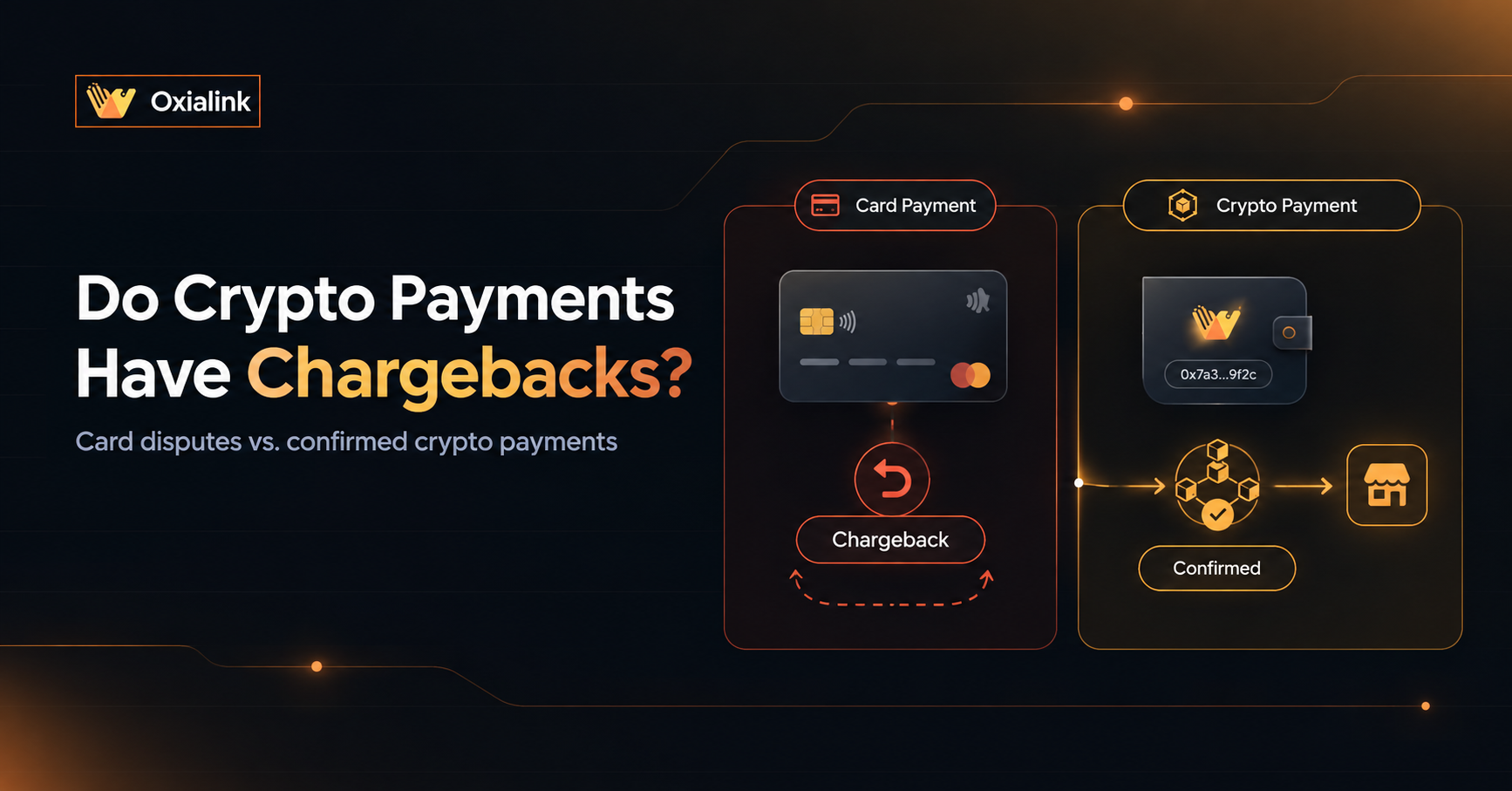
A customer pays with a credit card and later disputes the transaction. The card issuer can review the dispute and, in some cases, reverse the charge. Crypto payments work differently. Once a transaction is confirmed on-chain, there is generally no card-style chargeback mechanism that lets a third party reverse it. That does not mean merchants never need to deal with refunds, fraud, or payment mistakes. It means those problems have to be handled through different processes.
Do crypto payments have chargebacks?
Generally, no. A traditional card payment runs through a payment network and an issuer that can investigate disputed transactions. The Consumer Financial Protection Bureau explains that a credit card charge can be disputed through the card issuer, and in some situations the issuer can reverse the charge. A cryptocurrency transaction works differently. Once a transaction is confirmed on its blockchain, the network does not provide a card-style chargeback process. The FTC explains that cryptocurrency payments typically are not reversible. In most cases, getting the money back requires the recipient to send it back. That distinction is important for merchants because there is no standard post-settlement window where a card issuer can simply pull a confirmed crypto payment back.
Chargebacks vs. crypto payments
| Feature | Card payment | Confirmed crypto payment |
|---|---|---|
| Payment network | Card network and issuing bank | Blockchain network |
| Can the customer dispute the payment? | Yes, through the card issuer | No standard card-style chargeback process |
| Can the payment be reversed by the network? | In some circumstances | Generally no after confirmation |
| Who handles disputes? | Card issuer and payment processor | Merchant and customer, depending on the situation |
| Refund possible? | Yes | Yes, but normally through a separate refund process |
| Main merchant risk | Chargebacks and payment disputes | Fraud, incorrect payments, refunds, and operational mistakes |
The key point is that no chargeback does not mean no customer support. Merchants still need a clear way to handle legitimate problems.
Why are confirmed crypto payments generally irreversible?
The reason is built into how blockchain transactions work. When a customer sends cryptocurrency, the transaction is broadcast to the relevant network. The network validates it and records it on the blockchain. Once the required confirmation level is reached, the payment is treated as settled. There is no card issuer sitting between the customer and merchant with a standard chargeback procedure. For example, if a customer pays an invoice using USDT on TRON (TRC20), the transaction is recorded on the TRON network. Once the payment reaches the required confirmation level, the merchant can treat that transaction as confirmed. The FTC similarly notes that cryptocurrency payments typically are not reversible and that recovering funds generally depends on the recipient sending them back. This is one reason merchants should verify payment details before fulfilling an order.
No chargeback does not mean no refunds
A refund and a chargeback are two different things. A chargeback is initiated through a payment provider or card issuer. The customer disputes a transaction, and the payment system investigates whether the money should be taken back. A refund is normally initiated by the merchant. For a crypto purchase, a merchant can still decide to refund a customer. The important difference is that the refund is a separate transaction rather than a reversal of the original blockchain transaction. For example:
- 1A customer pays 100 USDT for an order.
- 2The payment is confirmed on-chain.
- 3The merchant decides the order should be cancelled.
- 4The merchant sends the appropriate refund amount back to the customer.
- 5The original transaction remains on the blockchain.
The original payment does not disappear. A separate transaction sends funds back. That makes refund policies particularly important for merchants accepting cryptocurrency.
What happens if a customer sends the wrong amount?
This is one of the practical issues merchants need to plan for. A customer might:
- Send less than the invoice amount.
- Send more than the invoice amount.
- Pay after an invoice has expired.
- Send the wrong cryptocurrency.
- Send funds on the wrong network.
- Send a payment to an incorrect address.
These situations are not chargebacks. They are payment-handling issues. The merchant needs to decide how each situation should be handled before accepting crypto payments at scale. For example, an underpayment should not automatically be treated as a fully paid order. The merchant can review the transaction and decide whether to request the remaining amount, refund the payment, or handle it according to the store's payment policy.
What happens when a customer claims they never paid?
With a card payment, a merchant may need to work with the processor and issuer to investigate a dispute. With crypto, the transaction can be checked directly on the relevant blockchain. A payment record can provide information such as:
- Transaction ID
- Sending address
- Receiving address
- Amount
- Cryptocurrency
- Network
- Confirmation status
- Block information
That makes payment verification an important part of a crypto payment workflow. Oxialink tracks payment transactions and confirms them against the blockchain before the payment is treated as confirmed. Its API documentation also provides invoice, transaction, and webhook endpoints for merchants building their own integrations.
How Oxialink handles confirmed crypto payments
Oxialink is built around on-chain payment confirmation rather than card-style payment authorization. For supported integrations, a merchant creates an invoice or payment request. The customer receives a payment address and pays with the selected cryptocurrency. The payment is then monitored on-chain. Once the required confirmation level is reached, the payment can be marked as confirmed and the merchant can fulfil the order. For example, Oxialink's USDT TRC20 payment page describes the flow as creating an invoice, having the customer pay to the unique address, confirming the transaction on-chain, and then crediting the merchant balance. Oxialink also supports signed webhooks and API-based integrations. Developers can use the Oxialink API documentation to create invoices, monitor transactions, and handle payment notifications.
What should merchants do instead of relying on chargebacks?
If your store accepts crypto, the goal should not be to recreate the card chargeback process. Instead, build clear payment and refund rules around the way blockchain payments actually work.
Verify payments before fulfilment
Do not mark an order as paid just because a customer says they sent cryptocurrency. Check that:
- The correct cryptocurrency was sent.
- The correct network was used.
- The amount meets the invoice requirement.
- The payment reached the correct address.
- The transaction has reached the required confirmation level.
Only then should the order move into fulfilment.
Make your refund policy clear
Customers should know what happens if they cancel an order or request a refund. Your policy should explain:
- When refunds are available.
- Whether refunds are full or partial.
- Which asset is used for the refund.
- Which wallet address the customer must provide.
- How long refunds normally take.
- Who covers any network fees, if applicable.
A clear policy reduces confusion after payment.
Keep transaction records
Store the invoice ID, transaction ID, amount, asset, network, order ID, and relevant timestamps. These records make it much easier to investigate a payment problem later.
Use unique payment details where possible
Assigning a payment address or invoice to a specific order makes reconciliation easier. Instead of trying to identify which customer sent a generic wallet transfer, the payment can be associated with the relevant order from the beginning.
Does having no chargebacks make crypto payments safer?
It makes one particular merchant risk different. A card payment gives customers a formal dispute mechanism. That can protect customers in legitimate cases, but it also creates chargeback exposure for merchants. Crypto removes the standard card chargeback mechanism after a confirmed transaction. That can reduce one type of merchant risk, but it does not remove fraud or payment mistakes. For example, a customer could still be tricked into sending cryptocurrency to the wrong address. The FTC warns that cryptocurrency payments typically do not have the same legal protections as credit and debit card payments and are generally difficult to reverse. So merchants should think of crypto as a different payment rail, not as a payment method with no risks.
What merchants need to remember
The answer to "do crypto payments have chargebacks?" is generally no. A confirmed blockchain transaction does not have the same dispute mechanism as a credit card payment. The customer cannot normally contact a card issuer and ask it to reverse the crypto transaction. But merchants still need a process for:
- Refund requests
- Underpayments
- Overpayments
- Wrong-network payments
- Duplicate payments
- Fraud reports
- Order cancellations
- Payment reconciliation
The important distinction is simple: A chargeback reverses a payment through a payment network. A crypto refund is a new transaction sent back by the merchant. For merchants, that means the best protection is not a complicated chargeback workflow. It is accurate payment verification, clear refund rules, good transaction records, and an integration that confirms payments before fulfilment. If you are evaluating crypto payment infrastructure, you can review Oxialink's fees, see how USDT TRC20 payments work, or explore the Oxialink API documentation.
Frequently asked questions
Do crypto payments have chargebacks?
Generally, no. Confirmed cryptocurrency transactions do not have the same card-style chargeback mechanism. The FTC says cryptocurrency payments typically are not reversible.
Can a crypto payment be refunded?
Yes. A merchant can voluntarily send funds back to a customer. This is a separate transaction and does not reverse the original blockchain transaction.
Can a customer dispute a crypto payment?
There is no standard card-style dispute process for a confirmed blockchain transaction. A customer can contact the merchant or the service used to send the payment, but recovery is generally not guaranteed.
What happens if a customer sends the wrong amount?
The payment should be reviewed against the invoice. Depending on the merchant's policy, the customer may need to pay the difference or receive a refund.
Are crypto payments completely irreversible?
A confirmed blockchain transaction is generally irreversible at the network level. However, a merchant can voluntarily return funds through a new transaction.
Does Oxialink support refunds?
A merchant can handle refunds according to its own store policy. A refund is separate from the original blockchain payment and should be recorded as such.
How does Oxialink confirm crypto payments?
Oxialink monitors transactions on supported networks and confirms payments after they reach the required confirmation level. Merchants can also use its API and signed webhooks to integrate payment confirmation into their systems. See the Oxialink API documentation.
Where can I check Oxialink's current fees?
The current fee schedule is available on the Oxialink fees page. Network fees are published by coin and plan pricing is shown separately.
Get started
Start accepting crypto today
Email address, password, first payment in under fifteen minutes.